Professional

Monday, December 31. 2012

JavaScript Cookie Check

It's strange to see that today in 2012 browser cookies are still making trouble. It shouldn't be that difficult to check with JavaScript if cookies are enabled in the browser. The non-standard navigator.cookieEnabled flag works correctly in Chrome, Firefox, Opera and Safari but Internet Explorer is simply lying to us! It supports this flag (It's not null or undefined) but it is always set to true! So we still need hacks for this browser. It's also strange that I wasn't able to find a working hack on the Internet. So I wrote my own:

/**
 * Checks if browser supports cookies.
 * 
 * @return {boolean}
 *             True if browser supports cookies, false if not.
 */
function supportsCookies()
{
    var cookieEnabled = navigator.cookieEnabled;
    
    // When cookieEnabled flag is present and false then cookies are disabled.
    // Thanks to IE we can't trust the value "true".
    if (cookieEnabled === false) return false;

    // Internet Explorer is lying to us. So we have to set a test cookie
    // in this browser (We also do it for strange browsers not supporting
    // the cookieEnabled flag). But we only do this when no cookies are
    // already set (because that would mean cookies are enabled)
    if (!document.cookie && (cookieEnabled == null || /*@cc_on!@*/false))
    {
        // Try to set a test cookie. If not set then cookies are disabled
        document.cookie = "testcookie=1";
        if (!document.cookie) return false;
        
        // Remove test cookie
        document.cookie = "testcookie=; expires=" + new Date(0).toUTCString();
    }

    // Well, at least we couldn't find out if cookies are disabled, so we
    // assume they are enabled
    return true;
};

Let's explain what this code is doing:

  • When the navigator.cookiesEnabled flag is present and is false then we definitely know that cookies are disabled. All major browsers except Internet Explorer will stop right here when cookies are blocked.
  • When navigator.cookiesEnabled flag is not present (maybe some really old browser) or when Internet Explorer is deteced (Checked with JScript conditional compilation) then a test cookie is set. But we only do this when there are no cookies already set (Because when there is already a cookie then cookies can't be disabled). When our test cookie can be read again then cookies are enabled, otherwise they are disabled.

The code works in IE7-10, Firefox 17, Chrome 23, Opera 12 and Safari 6.

What a shame that code like this is still needed in 2012...
Thursday, December 13. 2012

Friday, May 25. 2012

How to follow an organization on GitHub

For some reason GitHub does not display a Follow button on organization pages. So you can only follow normal users or repositories. This is pretty sad because it perfectly makes sense to follow an organization if you want to be informed about new repositories created by this organization. Following the organization members instead isn't an option because then you are also notified about their personal activity which might be boring to you. And some members are not even displayed as organization members because membership can be hidden.

Even more confusing is the fact that following an organization technically works. You can add yourself to the follower list and you are also correctly informed about new projects created by this organization. So why is GitHub not showing this button? Don't know. So you have to hack yourself into the follower list. This can be done with a single JavaScript command which you can enter into the JavaScript console of your browser (Naturally you have to be logged in into GitHub):

$.post("https://github.com/users/follow?target=organizationName");

You can also check the follower list of an organization (The link to this list is also hidden on GitHub). Here is an example URL: https://github.com/openwebos/followers. And when you check the Following list of a user which follows an organization then you can even see a Follow/Unfollow button for the organization. This is most likely a bug, GitHub simply forgot to remove this button when they introduced organizations (Which are simply special kinds of users).

Now I wonder: If it is possible to follow organizations and even notifications about new organization repos works then why isn't it an official feature?

Thursday, May 17. 2012

Fixing JavaScript Console in older browsers and IE

The JavaScript console as introduced by Firebug years ago has grown to a de facto standard in many web browsers. Especially the Webkit JavaScript console in Chrome/Chromium and Safari is extremely well done. Newer Firefox versions now also come with a built-in console. Even Internet Explorer comes with a basic console-like thing but unfortunately it sucks...

So far I used custom logging mechanisms or log4javascript to log messages in my JavaScript applications. Thanks to the JavaScript console this would be unnecessary if all browsers had descent support for it. But unfortunately the console implementations in some browsers are incomplete or completely absent. So even this harmless line of code in your application can prevent execution in Internet Explorer when the development panel is closed (In which case window.console is not defined at all):

console.warn("Config not found. Using defaults.");

So to be able to use all console features without worrying about missing browser-support I wrote a small library called console-shim which detects the implemented console features and tries to complete them. Some features are emulated so they fully work in all browsers while other features are silently ignored. If console logging is not supported by the browser at all then console-shim tries to use log4javascript if available or it silently ignores all logging attempts. See the README for a full list of replacement implementations for missing functionality.

Sunday, May 6. 2012

How to setup a modern HP printer in Ubuntu Linux

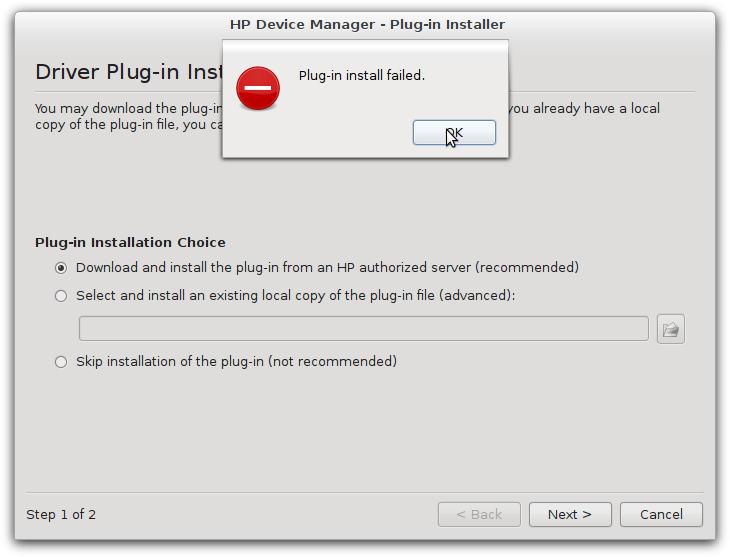
Are you the (un)lucky owner of a modern HP printer which needs a closed-source binary plug-in? And are you using Ubuntu Linux? Then you might know the detailed error message Plug-in install failed which occurs when you try to setup the printer with HP Toolbox (From the hplip-gui package shipped with Ubuntu):

Looks like there is a permission problem somewhere. Not sure if it is Ubuntu's or HP's fault. Running the HP Toolbox as root might fix the problem but unfortunately it refuses to run as root. But there is an easy way to work around this problem. When you try to install the plug-in the HP Toolbox downloads a plug-in installation script from an HP server to your /tmp directory. It then executes it (Without root privileges I guess) which fails. That's why you get the Plug-in install failed error message. Cancel all dialogs and close the HP Toolbox and execute this command in your terminal:

sudo bash /tmp/hplip-3.12.2-plugin.run.1

The version number may be different so check out which files are located in your /tmp directory first. You'll have to confirm the license and after the installation is complete it will print Done to the console. When it didn't print Done then something went wrong. Maybe you forgot to execute it with sudo? When the installation was successful then start the HP Toolbox again and setup your printer. The tool will not try to install the plug-in again because this time it is already there and it works.

Happy printing (and happy scanning and faxing if your printer supports it)!